Pricing research and pricing optimisation
 Pricing is one of the more technical areas of market research, and is central to businesses practising value-based pricing. Price modelling and market models are a fundamental part of pricing research to estimate demand, price sensitivity or elasticity, in order to plan a pricing strategy to deliver maximum value. The aim is not to find what customers like, but what they are willing to pay and so identify the optimum price point that will maximise profit, revenue or market share.
Market context, positioning and price strategy are extremely important in setting prices - what are you trying to do with your prices - win share or maximise revenue or profits? And how are you planning to structure the pricing for sales and value. In business markets "value-in-use" or "total cost" may be more important than absolute price.
The four main pricing research methods
There are four main approaches to pricing research, the Gabor-Granger technique, van Westendorp Price Sensitivity Monitor, Brand Price Trade-off and Conjoint Analysis (also known as Discrete Choice Analysis). Some techniques can be used off-the-shelf and many companies sell branded pricing research packages that are just a variation on one of these techniques, however selecting the right technique ultimately depends on what the problem is you are trying to solve. Discover our interactive pricing explorer to understand the business impact of pricing.
Gabor-Granger (direct pricing or likelihood of purchase estimation)
Gabor-Granger is the simplest form of pricing research, named after the economists who invented it in the 1960s, and is also know as direct pricing. Customers are asked to complete a survey where they are asked to say if they would buy a product at a particular price. The price is changed and respondents again say if they would buy or not. The pricing question can vary from an open end - what is the maximum you would pay, to a pricing ladder working through a set of prices, to a likelihood of purchase scale, or asking about specific prices at random to avoid anchoring.
From the answers, the optimum or maximum price is established for each individual in the sample. By taking a sample of customers, we can work out what levels of demand would be expected at each price point across the market as a whole (the demand curve in the following graph).
Using this estimate of demand, the price elasticity (or expected revenue) can be calculated and so the optimum price-point in the market established. Note that a revenue optimum may be different from a profit optimum. The ability to model dynamically is extremely valuable in pricing studies to estimate revenue and profit effects.
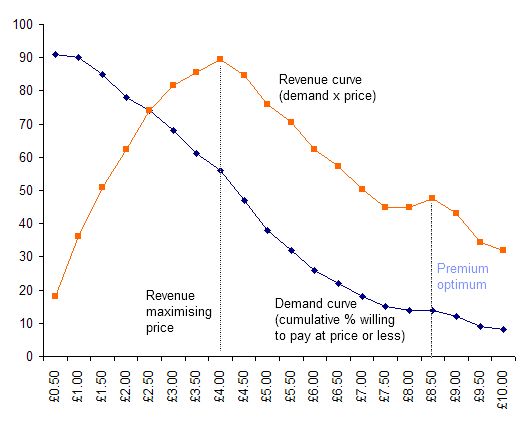 A weakness of Gabor Granger is that customers may understate the price they will pay (there are also circumstances in which they will overstate the price). Consequently the phrasing of the "would you buy" question is extremely important as are other contextual questions to place the customer in the buying frame of mind.
Typically, Gabor Granger is only used when considering one product in isolation, whereas in real life they would face a choice about which product to buy. Competitive response to different prices cannot be gauged from Gabor Granger and knowing customers what would pay is useful, but not if competitors are offering the same product for less.
There are a variety of ways of asking the questions including asking for a price directly, or asking for a rating of likelihood to buy. Likelihood to buy results have to be weighted to try to produce an estimate of take-up as they commonly overestimate potential demand.
Van Westendorp Price Monitor
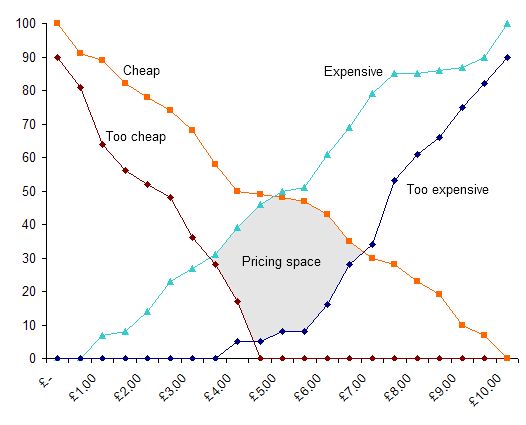 An alternative variation on direct pricing is called Van Westendorp price sensitivity monitor. The aim is to establish price perceptions for a product in a market. Respondents are asked four questions to determine what prices are too cheap, where a price is a bargain, when a price is expensive and where a price is too expensive.
By plotting the cumulative curves for each of the four prices, the crossing points are deemed to be optimum points according to different criteria. The resultant price "space" helps to determine the range of acceptable prices - and so pricing tactics - available.
Typically, vW is a technique which is more for price positioning type studies than for estimating optimum pricing, as with the Gabor Granger, there is no competitive element and it assumes respondents know the market. It also gives no direct measure of likelihood to buy. For this reason the van Westendorp is often combined with direct pricing questions, or used as a starting point for a conjoint analysis or BPTO pricing exercise.
Conjoint analysis
The main recommended market research technique for pricing uses Conjoint Analysis (also called Discrete Choice Modelling, or State Preference analysis) and has a strong reputation as being more robust and more reliable than other research techniques in assessing price sensitivity with fewer of the biases of direct pricing methods.
The focus of Conjoint analysis is looking how choices are made from a given set of different potential product specifications with different prices, from which the importance of price and price elasticity or price sensitivity obtained.
For some specialists, conjoint analysis is the only way of carrying out pricing research, and in particular Discrete Choice Analysis (a subset of conjoint) is often used to estimate price elasticities for brands in supermarket style layouts. However, conjoint analysis is a more technical form of research and requires higher levels of design skills. If pricing is to be conducted it is often advantageous to include it as part of a broad conjoint study into product and service features.
In conjoint analysis, customers trade off price against other product features, price against brand alone. By looking at how customers make decisions, economic impact of price changes can be assessed as can 'balanced-value' positions for price positioning
A key output from the conjoint analysis is not just what the measures of price sensitivity are, but also a market model that can be used to investigate both what the optimum is if nothing changes, but can also investigate competitor response and potential profitability by building in fixed and variable costs. In more dynamic pricing models such as transportation or leisure markets, these models can be used by yield managers to help guide ticket 'buckets' for time sensitive pricing
Brand Price Trade-offs (BPTO)
For brand specific studies measures of brand equity and category management Brand Price Trade-off Studies (BPTO) can be used. Here customers evaluate products just using brand and price. In contrast to conjoint analysis, where prices are adjusted according to a randomised statistical plan, for BPTO prices are adjusted systematically increasing the price of the chosen products, up to the point at which customers stop purchasing.
From a respondent point of view, BPTO is often easier for respondents to follow as they can see how prices are being adjusted depending on their choices. However, this is also partly a downside as it makes it easier for respondents to game the research. Typically BPTO requires some advanced programming in survey design and care has to be taken coding and analysing the outcomes.
Like conjoint analysis, BPTO also products a market model allowing optimisation and what-if games to be played with varying price points
Behavioural economics
Most price research approaches assume that pricing is dealt with in a rational manner. Increasingly behavioural economics shows that reactions to prices can be conditioned by other factors and the structure and presentation of pricing options will affect choice. Factors like anchoring (using one price to judge a second price) and framing can be important, particularly in product ranges where there are both price per item, but also relative prices between different products to be considered.
For some markets where prices are very visible, or where there is a large amount of internal pricing data, it is possible to use econometric methods to examine the impact of price and to understand price elasticities. Using pricing tests, discounts and advanced statistical analysis the impact of price can be assessed live in the real world.
The most common approach to pricing research is to rely on market intelligence and follow-my-leader type pricing using a competitor as a benchmark. However a me-too approach leads to high levels of competition, and it is important to consider the strategic impact of pricing as well as the short term sales impact.
Some caution is needed when conducting pricing studies. Statistically speaking, where you are looking to optimise prices where you are looking at relatively small price changes of 5-10%, you will need larger than normal sample sizes to get the statistical accuracy you need. For many companies this can make pricing research expensive, unless combined with a range of other measurement.
It is also important to consider psychological effects like anchoring in price research. The price-range shown and the first values shown can influence perceptions of what is appropriate, or cheap or expensive, particularly in markets where prices are largely unknown such as infrequently purchased or specialist goods.
Qualitative research
In general qualitative research is not recommended for pricing optimisation studies. Qualitative research can be useful when a price list or price structure has become too complex, but in general when you ask people about prices in a qualitative setting, prices are always too high, or not transparent, and respondents will tend to negotiate with the researcher so it is not possible to produce estimates of demand at different price points.
In B2B context, price might be a component part of a depth interview aimed at understanding value and satisfaction, and therefore help with tuning pricing within a key account context. However, aggregated data and demand curves are not possible from purely qualitative research.
We offer a full range of research and consultancy services around approaches to pricing and can help guide you through the sensitive questions about finding out what customers value, and what they are willing to pay for.
For help and advice on carrying out pricing research and setting pricing strategies contact info@dobney.com


