Conjoint analysis demonstration
 The aim of conjoint analysis and choice research is to predict how purchase decisions will be made by working out what customers value, based on the choices they make. If a business knows what customers really value, they can use this focus their strategic effort on the areas that matter most to customers (see the market modelling example).
The demonstration below is a simplified example of a conjoint exercise and works best if you are consistent in your choices (see the technical notes for more information and a comparison with full/commercial conjoint analysis).
To explore more deeply, our free, fully-interactive Conjoint Explorer allows you to play with attributes and levels and conjoint analysis designs.
How to use this conjoint demonstration...
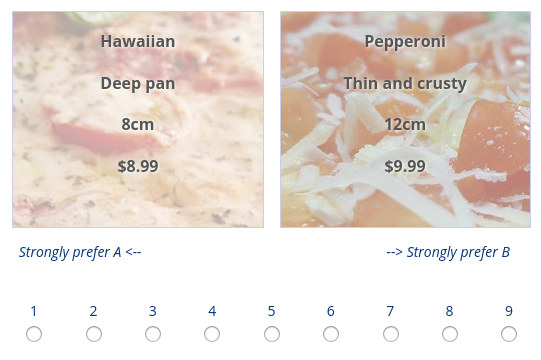
Suppose you are buying a Pizza for tonight. Two options are shown below. Pick a point on the scale to show your preference. If you strongly prefer Left Hand Pizza select a low number. If you strongly prefer the Pizza on the right select a high number. If you have no preference choose 5. Then click [Enter] to see a new pair of options.
The charts show estimates of what is driving value in your choices - known as utilities or path-worths. To begin everything is valued at zero, but slowly the estimator learns your preferences and moves the scores. To see accuracy, the calculated expected choice is also shown
Understanding how the demonstration works...
Size, type, base and price are called attributes, the component parts are levels per attribute, that make up the pizza (see conjoint design). The charts show utilities or part-worths estimated from the conjoint choice tasks that have been completed. After each choice-task, the algorithm adjusts what it thinks is driving decisions and calculates what it expects to be the next choice from the new options. You can adjust the charts by hand to see how the utility-scores affect the expectation.
Why conjoint analysis is important for businesses
For businesses, the value of these types of results comes in the ability to fine-tune product and service offering against cost and pricing considerations. People always have to choose between high price, high quality and low price, low quality, but this means there is a sweetspot somewhere in the middle. How do you optimise the value you can deliver for the customer against the costs involved? How much more should you charge for a larger pizza for instance? And do different types of base have different values to customers and so indicate different willingness to pay?
How this demonstration differs from real conjoint analysis
The demonstration is a simplified version of conjoint analysis and will continue indefinitely. In particular it is using a randomised selection method for each product profile. In a standard conjoint analysis, the profiles are generated according to a statistical plan (fractional factorial design) that optimises the estimations.
Secondly, the estimation algorithm calculates utilities (also known as part-worths) after every choice. In full conjoint, calculations are carried out at the end, across the sample as a whole. However, after 10-12 choices, the QuickLearn algorithm should show a fairly good representation of the items you like against the items you don't like if your choices are consistent. More information can be found in our conjoint demonstration technical notes about the demonstration.
Discovering more about conjoint analysis...
Hundreds of thousands of conjoint analysis studies have been carried out around the world, but it still remains relatively unknown even among market researchers. A fuller history of conjoint analysis describes the development and progress behind conjoint analysis. We have used conjoint analysis internationally over more than 20 years in projects ranging from simple product design, pricing, range planning, service design and even areas like employee benefits.
A core part of conjoint analysis is making the tasks realistic to reflect real decision making. As part of our Cxoice Survey Technologies, our conjoint designer allows full control over the display and tasks that can be used from configurators to menu-based designs, or e-commerce mock ups. This allows us to extend conjoint to areas like emotional associations and makes it more applicable for things like repertoire purchasing where a customer is buying a bundle of products, not just individual products.
See also...
- See simple full-profile conjoint analysis in Excel showing how the utilities are calculated
- Play with our interactive Conjoint Explorer to explore attributes and levels and conjoint designs
- See how market models to make better business and marketing ROI decisions
For expert help and advice on carrying out conjoint analysis for your market contact our conjoint analysis experts info@dobney.com
Discover more...


