Conjoint analysis learning resources
Conjoint analysis is an powerful market research method used by product and service designers for forecasting how different product, service and pricing options drive what customers choose, and value. Our learning resources take you through everything you need to know to make a successful conjoint project.
 Do customers go for high-price, high-quality or low-price, low-quality or somewhere in between? Identifying the right balance point is a classic business problem. Conjoint analysis quantifies and models this decision-making, measuring what customers really value to identify the best solution for the business.
This section explains all about conjoint analysis from principles to models, to advanced options and alternative methods. Discover our conjoint demonstration and pricing explorer to explore how these techniques improve business decisions.
We provide a full range of conjoint analysis solutions, training and consultancy from basics like CBC upwards, to interactive models and forecasts to understand what drives purchase decisions and uncover customer price sensitivity to optimise your products and services. For any questions about carrying out conjoint analysis, contact our helpful team for advice or information.
Large-Scale Conjoint
Large-Scale conjoint is about making conjoint analysis look and feel like much larger e-commerce systems, where products have a large number of attributes and where there is textual noise and variation. To do this means updating a number of elements of conjoint analysis from what is shown to the way people choose, to the analysis required.
- More...
- What is conjoint analysis? The complete guide

 Conjoint analysis is a superior market research method that evaluates how people make decisions when choosing products and services. It is used to quantify what customers really value, and to create models and forecasts based on presenting people with realistic product choices and then analysing what features most drive purchasing decisions.
Conjoint analysis is used to build market models and forecasts to answer questions such as "Should we build in more features, or change our prices?" or "Which of these changes will hurt our competitors most?", or "What is the optimum price to charge?" that allow the business to optimise product and service design to customer needs.
- More...
- Conjoint Explorer
The Conjoint Explorer is a fully interactive app for seeing and testing conjoint analysis in action. It includes:
- multiple conjoint design types (from simple to advanced, including MaxDiff)
- a design editor to change designs and work on attributes and levels,
- an estimator to see how choices turn into calculated utility values and path worths,
- and a live model translates utility scores into estimates of share of preference.
For non-specialists and students the Conjoint Explorer provides a practical method to understand conjoint analysis. For Conjoint Designers and researchers, it provides a live tool to assist in the creation of attributes and levels, and exploring different presentation formats for more realistic conjoint analysis design.
- More...
- Using the Interactive Conjoint Explorer
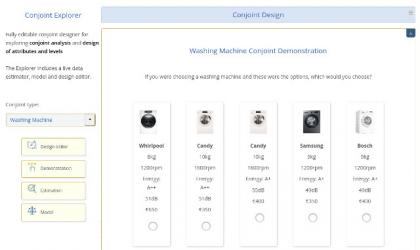
Our how-to guide for the dobney.com Conjoint Explorer application for developing conjoint analysis designs and discovering how conjoint analysis works.
We explain the different parts of the Conjoint Explorer, and how to change design and how to edit, update and test the design interactively. There is no software to download, and no need for a subscription, it is fully-interactive and fully-editable to help play, develop and understand conjoint analysis ideas.
- More...
- Conjoint analysis demonstration
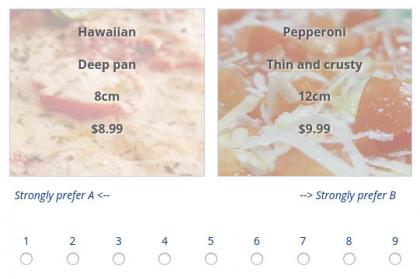
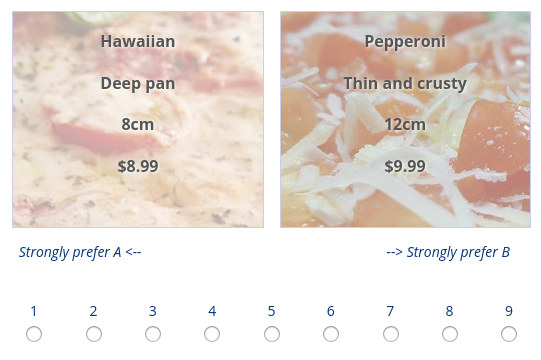 The aim of conjoint analysis and choice research is to predict how purchase decisions will be made by working out what customers value, based on the choices they make. If a business knows what customers really value, they can use this focus their strategic effort on the areas that matter most to customers (see the market modelling example).
The demonstration below is a simplified example of a conjoint exercise and works best if you are consistent in your choices (see the technical notes for more information and a comparison with full/commercial conjoint analysis).
To explore more deeply, our free, fully-interactive Conjoint Explorer allows you to play with attributes and levels and conjoint analysis designs.
- More...
- Conjoint analysis design and attributes and levels

 Conjoint analysis and trade-off studies are amongst the most powerful forms of market research. The aim is to quantify the underlying values (utilities or part-worths) that drive customers' decisions, and then to build models of demand and market forecasts, in order to optimise product or service features.
The quality of the outputs depends on creating a good quality, realistic, design. For conjoint analysis, in particular this means choosing the right flavour or type of conjoint to use and ensuring that the design of the attributes and levels, the way the profiles are shown and the number of choice tasks matches the real world, while also stress-testing business plans and strategies.
- More...
- Flavours or types of conjoint analysis

 For those new to the subject of conjoint analysis, it is easy to believe that there is only one type or version of conjoint analysis (the one type your agency knows). Or the reverse, and become bewildered by the number of abbreviations and names - eg ACA, CBC, MPC, ACBC, full profile, stated preference, DCE/discrete choice estimation among others.
Most conjoint analysis studies carried out professionally use Choice-based Conjoint (CBC) for pricing and brand value studies. Newer adaptive types of conjoint such as Adaptive Choice-Based Conjoint (ACBC) or menu-based conjoint are used for more complex studies. MaxDiff is a commonly used adjunct or substitute for conjoint analysis with large numbers of items. However, different types or "flavours" can be used, depending on the task at hand, and might incorporate Buy-your-own tasks, configurators or take the basic principles and extend them to create tailored designs for specific markets.
- More...
- Conjoint analysis - market modeling demonstration
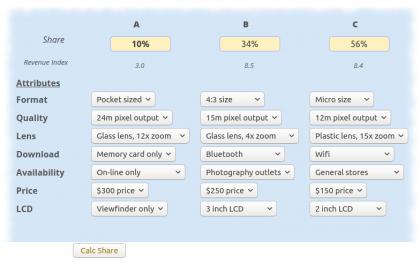
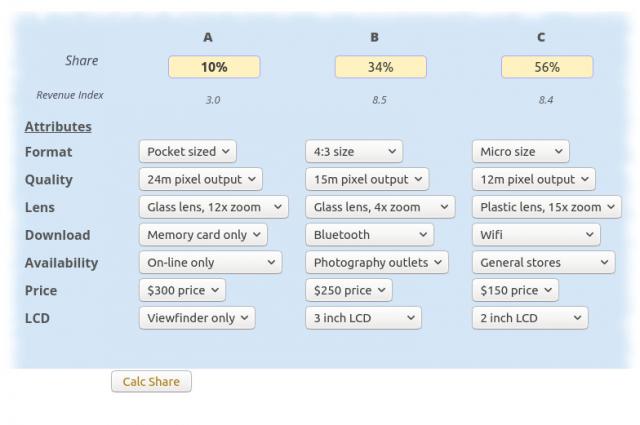 Modelling is a core part of a conjoint analysis market research study. This demonstration shows how understanding choices can be used to predict market share (strictly "share of preference") and possibly revenue or profit potential by changing product features. Our Cxoice Conjoint Explorer shows the full link between attribute design to model output to explore conjoint analysis methods.
Other types of pricing and trade-off research also lead to other types of market models for example as Pricing research or Brand-Price Trade Off research. Models are a major benefit of conjoint and trade-off studies over other forms of quantitative market research.- More...
- Conjoint analysis applications

 Conjoint analysis is used in a wide range of different market research and insight applications from copy testing, to pricing research to product and service design, to defining membership schemes. The list of applications is relatively long as conjoint gets adapted to different purposes. For instance it's possible to use some of the design principles to develop and test areas like website or promotional message design using live in-market testing. Below is a list of common uses.
- More...
- Conjoint analysis for international markets

 As an advanced market research technique, conjoint analysis is most commonly used by larger businesses and for multinationals operating across several countries where it is important that product design and business strategies reflect both global and local needs.
In contrast to traditional scale-based rating approaches, conjoint analysis and techniques like MaxDiff are less affected cultural differences in the way people give ratings in different countries. Consequently international conjoint projects can be an effective method of understanding common needs and desires across global markets.
- More...
- Top 10 mistakes when using conjoint analysis
Conjoint analysis counts as one of the more sophisticated, and powerful, techniques of market research. It's aim is to estimate what drives customer value, and to say what customers would buy when faced with different products at different prices. But it gets the power and insight due to careful design and appropriate analysis. Inexperienced users can create poor designs without realising it, and research users can have poor experiences with conjoint analysis because the agency or consultants do not really understand what is involved.
- More...
- Alternatives to conjoint analysis

 Conjoint analysis is a widely established market research technique for understanding how people value the component elements that make up a product or service - the attributes and levels. However, in certain circumstances, for instance where there are lots of attributes to consider, or where bundles are being built, it may be better to consider alternatives such as MaxDiff, Configurators, Simalto or a range of other more bespoke designs and choice tasks.
Note that we would consider options such as Discrete Choice Modelling (DCM), stated preference research and elements like shop-display tests for pricing as 'flavours' of conjoint analysis rather than purely distinct.
- More...
- History of conjoint analysis

 The earliest forms of conjoint analysis can be traced back to the 1970s having developed from the psychology of decision making and econometric choice theory.
Key developers have been Paul Green (Marketing use of decompositional models), Jordan Louviere (Choice-based conjoint) and Rich Johnson (Sawtooth Software and Adaptive conjoint methods) and more recently Sawtooth has pioneered a number of new approaches.
- More...
- MaxDiff and hierarchy of needs studies
MaxDiff and Hierarchy of Needs studies are used In new product development, concept testing and building marketing messages to identify what customer priorities are for development or marketing communications. Often businesses have a long list of potential product benefits and the key is in identifying which to prioritise and which work best with which audience.
Our specialist MaxDiff or hierarchy of needs studies allow you to test up 40 or 50 benefits in one go, both singularly and in packages so you know where customer priorities lie. These are designed to be very quick and simple to carry out, but to produce market models that allow you to see how combinations of options compare against each other.
- More...
- Simple but complete full-profile conjoint analysis
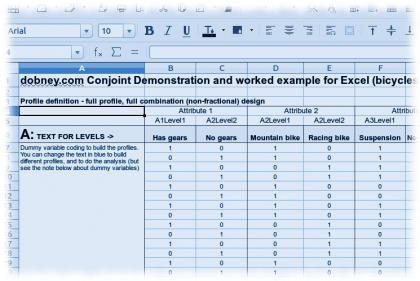
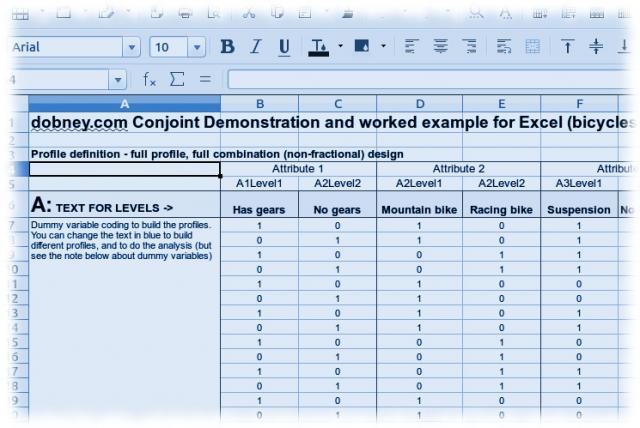 Many people ask how the elements of conjoint analysis relate to each other - how do you assign attributes and levels, build profiles and get to a calculation of part-worths or utility scores. In can be easy to talk about conjoint analysis in abstract without quite getting the practical 'this is how it works' element.
One of the original flavours or types of conjoint analysis is Full Profile and this is relatively simple to demonstrate. The attached Excel spreadsheet ? shows how a simple small full-profile conjoint analysis design can be built and analysed using Excel.
- More...
- Conjoint demonstration - the technical notes

 Our basic conjoint demonstration is a simplified example of a conjoint exercise to illustrate how choices can be turned into estimates of value. The calculations it uses to estimate the "utility" values, or part-worths associated with the choices being made (as shown on the bars) are simplified. This article outlines some of the technical notes and issues around the demonstration. Also check out the dobney.com Conjoint Explorer for more in-depth examples.
- More...


