

MaxDiff and hierarchy of needs studies
MaxDiff and Hierarchy of Needs studies are used In new product development, concept testing and building marketing messages to identify what customer priorities are for development or marketing communications. Often businesses have a long list of potential product benefits and the key is in identifying which to prioritise and which work best with which audience.
Our specialist MaxDiff or hierarchy of needs studies allow you to test up 40 or 50 benefits in one go, both singularly and in packages so you know where customer priorities lie. These are designed to be very quick and simple to carry out, but to produce market models that allow you to see how combinations of options compare against each other.
MaxDiff
MaxDiff is used where there are a list of possible items that need to valued individually. In this approach a long list of items is divided into a number of choice tasks consisting of choosing the most preferred and least preferred option from a list of four.
| Item | Most preferred | Least preferred |
| Fresh Salad | ||
| Pasta | ||
| Tomato | ||
| Fish |
By asking a series of these types of questions, the list most and least preferred can be identified, relative values or utilities can be calculated, similarly to conjoint analysis. By using Heirarchical Bayes and appropriate statistical design, the number of choice screens can be reduced to a manageable level. If this is combined with threshold questions about acceptability, then acceptable and unacceptable items can be isolated.
Hierarchy of needs
In product or marketing development it is common to face a situation where a new concept has been brainstormed generating 30-40 different ideas for possible inclusion leaving questions over prioritisation and which will have the most impact for customers, and the multiple choice of which to combine.
In our hierarchy of needs studies we take these priorities and get customers to rate and rank them in such a way that we can look at where the priorities lie, but also produce market models to show how different sets of needs can be combined to generate the largest share of preference in the market.
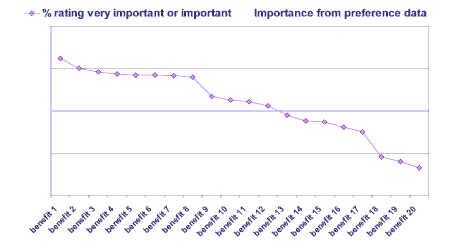
A common approach to this task is by simply asking what is important via a rating scale. The problem is that for many customers everything is important. The following chart shows a list of benefits ranked by importance. You will see there is no discrimination between the top 10 items.
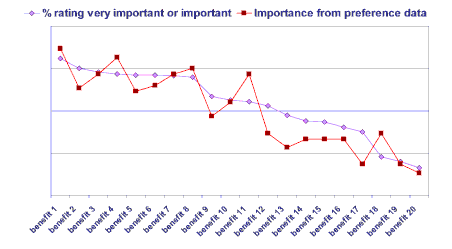
However, when you look at the data revealed from the hierarchy of needs preference approach there are clear distinctions between the different benefits. In particular, benefit 11 is actually more important than first thought because this is particularly important to one subgroup.
Click-to-rank
An alternative to MaxDiff is to use a pure ranking approach. Ranks need not be complete, as the same techniques for partial selection used for MaxDiff can also be used in a series of ranking questions. Some approaches to ranking (eg drag and drop, or entering a number to indicate preference) are clumsy and difficult for respondents. We use a 'click-to-rank' approach, which is smooth, easy and natural and makes it much easier to collect preference ranks - whether top 1, top 3 or more.
Respondents are able to scan and select across a large number of items, allowing more realistic tasks to be built, occasionally requiring an initial selection for consideration, followed by a final rank preference. In addition, click-to-rank approaches can be enhanced with sort and filter tools and then presented in standard e-commerce type layouts or formats. The benefit being that the added realism, can be validated and cross-checked against real purchase decision making more easily.
Modelling and analysis
A hierarchy of needs or MaxDiff study produces output similar to that of conjoint analysis, but is far quicker and simpler to carry out. The main benefit over conjoint is the ability to look at the presence or absence of different items and the value of items in combination - go, no-go decisions as opposed to more complex attributes and levels of conjoint.
In simple terms it is a bit like choosing what range of dishes to offer on a menu for customers. Diners want a choice, but the business want to optimise that choice so it appeals to the most people and meets the most needs without leaving left overs. This is similar to the objectives of TURF analysis - Total Unreplicated Reach and Frequency - what's the minimum set of products that appeal to the maximum number of people.
In the example below we look at which of combinations of options is most valued by the market and with an aim of maximising coverage and reducing the number of those who Would Not Buy (WNB).
| Fresh Salad | Fries | WNB | |
| Pasta | Fish | ||
| Tomato | |||
| Share | 30% | 45% | 25% |
If the menu is changed the question is does it give better coverage - will more people find something they like and so will the Would Not Buy (WNB) value go down. For instance subsituting steak for fish.
| Fresh Salad | Fries | WNB | |
| Pasta | Steak | ||
| Tomato | |||
| Share | 30% | 57% | 13% |
This type of packaging and combinations is common in marketing and category management to build the right portfolio of products with the right marketing messages offering key product benefits from the selection of all that are possible.
For help and advice on carrying out hierarchy of needs or other trade-off projects contact info@dobney.com


